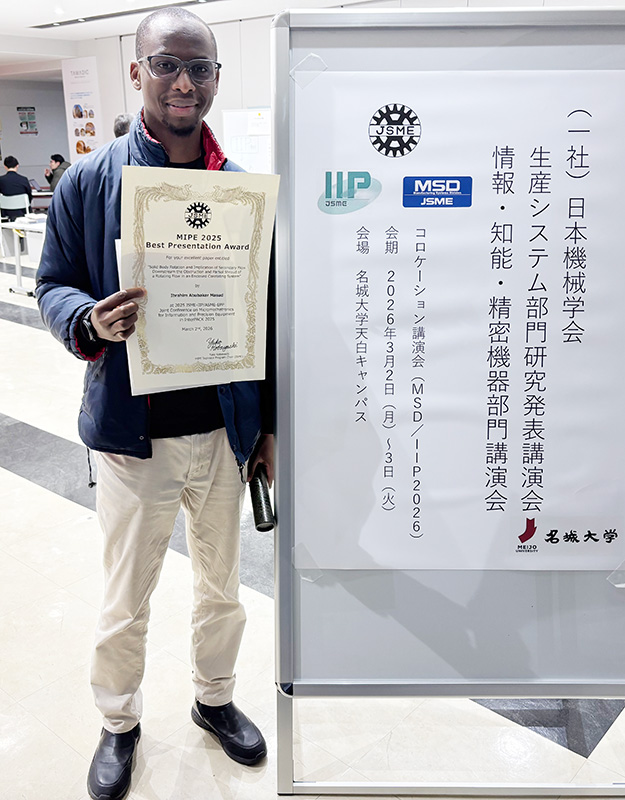
マスード イブラヒム アブバカールさんが IIP2026 にてベストプレゼンテーションアワードを受賞
2026/03/12
- 地域環境システム専攻
受賞者
マスード イブラヒム アブバカール(Mr. Masud Ibrahim Abubakar)
地域環境システム専攻 (Regional Environment Systems)
地域環境システム専攻 (Regional Environment Systems)
指導教員
白井 克明 教授(工学部)
学会・大会名
日本機械学会2026年度 情報・知能・精密機器部門講演会(IIP2026)
Japan Society of Mechanical Engineers, Information, Intelligence and Precision Equipment Division Meeting 2026
Japan Society of Mechanical Engineers, Information, Intelligence and Precision Equipment Division Meeting 2026
賞名
日米機械学会合同開催 情報・知能・精密機器部門 国際会議 2025 ベストプレゼンテーションアワード
MIPE 2025 Best Presentation Award at 2025 JSME-IIP/ASME-EPP Joint Conference on Mechatronics for Information and Precision Equipment in InterPACK 2025
MIPE 2025 Best Presentation Award at 2025 JSME-IIP/ASME-EPP Joint Conference on Mechatronics for Information and Precision Equipment in InterPACK 2025
発表題目
Solid Body Rotation and Implication of Secondary Flow Downstream the Obstruction and Partial Shroud of a Rotating Flow in an Enclosed Corotating System
研究内容
Disk-driven flows play a crucial role in numerous applications, including astrophysical and geophysical systems, turbomachinery such as turbines and pumps, artificial heart devices, and hard disk drives (HDDs). In this work, a non-axisymmetric corotating model was designed, incorporating an inserted obstruction and a partially open shroud, distinguishing it from conventional axisymmetric configurations. Flow measurements and analysis were conducted using a two-dimensional, two-component particle image velocimetry (2D2C PIV) technique. The findings demonstrate the existence of secondary flows both upstream and downstream of the obstruction within the inter-disk planes, consistent with trends observed in axisymmetric systems. Moreover, solid-body rotation developed in the vicinity of the hub, with its degree of establishment influenced by the arm insertion angle. Based on the overall flow characteristics, the streamwise domain was categorized into distinct spatial flow regimes, offering valuable insight for the optimization and performance enhancement of corotating system designs.
研究目的
Disk-driven flows play a crucial role in numerous applications, including astrophysical and geophysical systems, turbomachinery such as turbines and pumps, artificial heart devices, and hard disk drives (HDDs). In this work, a non-axisymmetric corotating model was designed, incorporating an inserted obstruction and a partially open shroud, distinguishing it from conventional axisymmetric configurations. Flow measurements and analysis were conducted using a two-dimensional, two-component particle image velocimetry (2D2C PIV) technique. The findings demonstrate the existence of secondary flows both upstream and downstream of the obstruction within the inter-disk planes, consistent with trends observed in axisymmetric systems. Moreover, solid-body rotation developed in the vicinity of the hub, with its degree of establishment influenced by the arm insertion angle. Based on the overall flow characteristics, the streamwise domain was categorized into distinct spatial flow regimes, offering valuable insight for the optimization and performance enhancement of corotating system designs.
研究目的
The objective of this study is to advance the development of non-axisymmetric disk-driven flow models representative of practical systems such as HDDs. In HDDs, flow-induced vibrations can affect the head flying height, increasing the likelihood of read/write errors and ultimately constraining further improvements in recording density. Because simplified models serve as essential benchmarks for understanding the fundamental behaviour of disk-driven flows in corotating systems, this work focuses on establishing a spatial classification of flow regions along the streamwise direction in the presence of an inserted obstruction. Such a framework is intended to bridge the gap between idealized models and real-world applications.
今後の展望
Flows generated by stacked rotating disks inside a container with non-axisymmetric geometry tend to display unsteady and highly complex three-dimensional behavior. Although this study was motivated by airflow phenomena in HDDs, the insights gained are expected to extend beyond this specific application, contributing to a broader understanding of rotational flows in fluid machinery. Future work will aim to further clarify these unsteady and intricate flow structures through a combined approach, integrating detailed experimental measurements with comprehensive three-dimensional numerical simulations.